
Toyota Automated Logistics combines Bastian Solutions, Vanderlande’s warehousing business, and viastore under one unified brand.

We deliver innovative warehouse automation solutions that enable our customers to achieve a sustainable competitive advantage.

Search toggle

Automated Guided Vehicles (AGVs) and Autonomous Mobile Robots (AMRs)

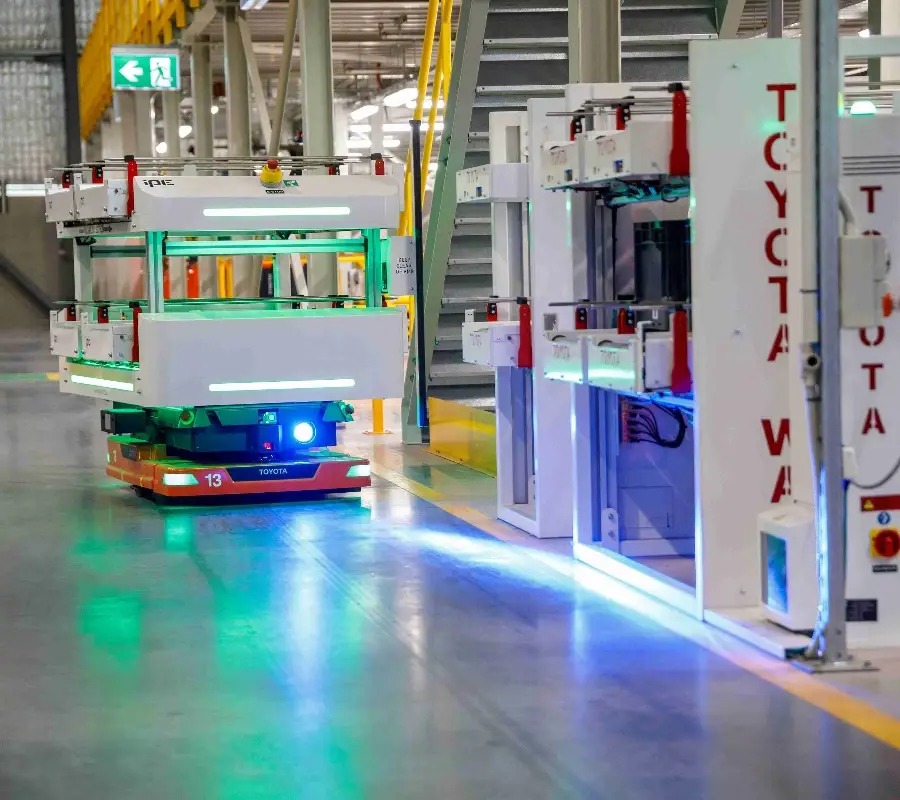
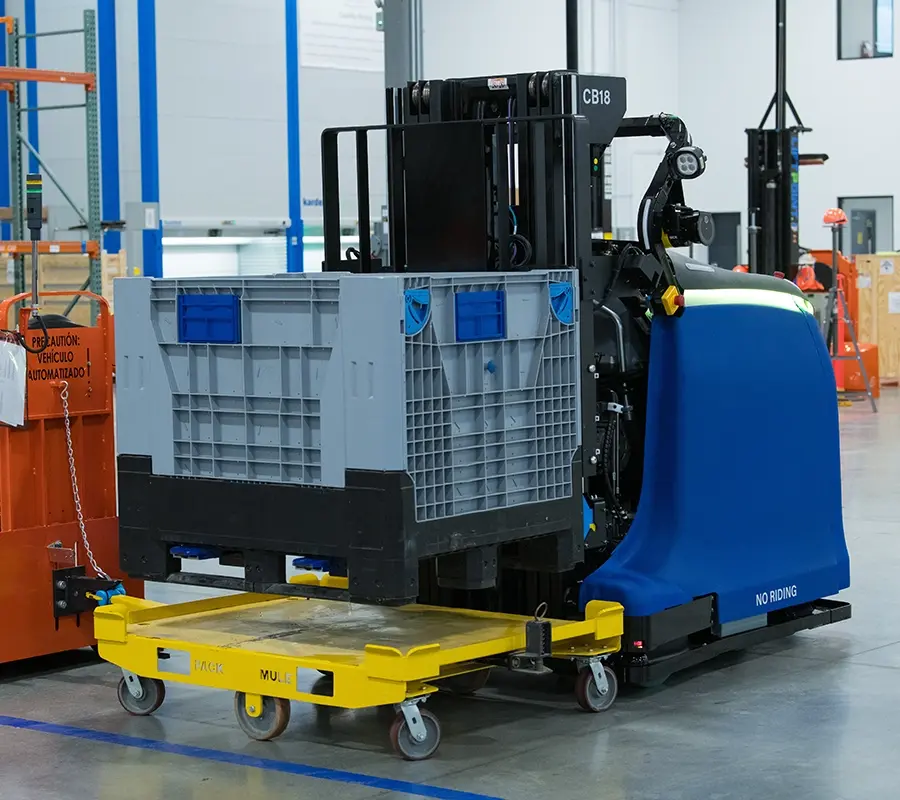
Toyota autonomous mobile robot navigating a warehouse floor using advanced sensors and lighting.

Automated Guided Vehicles (AGVs) and Autonomous Mobile Robots (AMRs) provide safe, reliable material transport for warehousing and manufacturing environments. Designed to move products with consistency and precision, these systems reduce labor dependency, improve throughput, and adapt to changing facility demands without fixed infrastructure.

Toyota Automated Logistics designs, integrates, and supports warehouse AGV and warehouse AMR systems that align with your operational goals — whether that’s stabilizing internal logistics, increasing flexibility, or scaling automation over time.
Overview

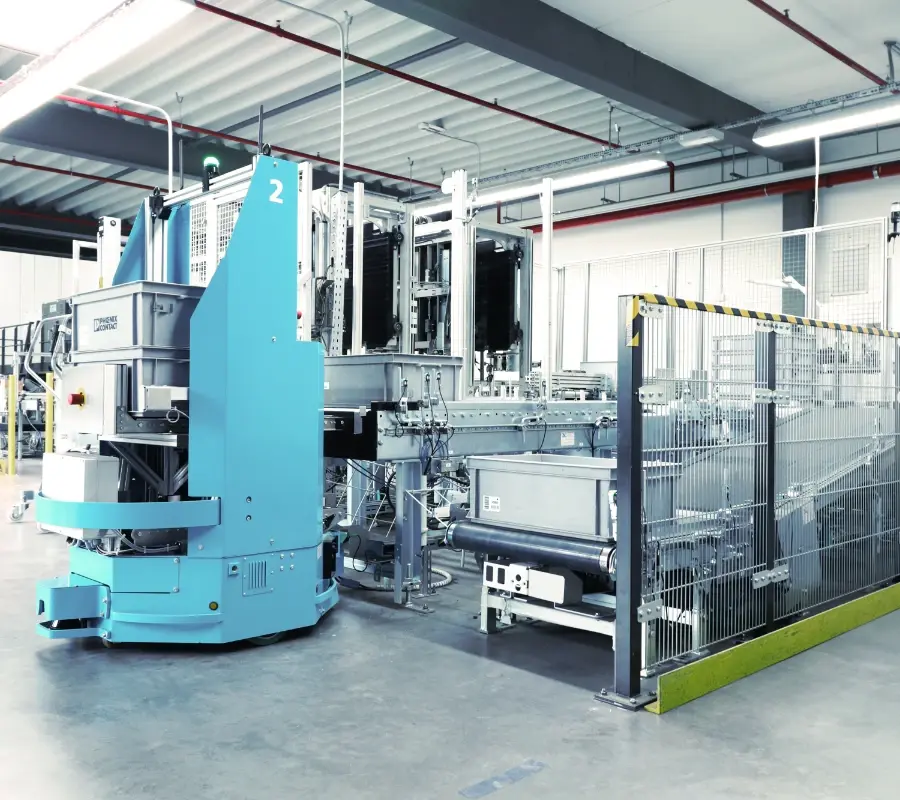
A blue automated guided vehicle (AGV) interfaces with a conveyor system in a modern industrial facility.

What it is: AGVs and AMRs are vehicles that automatically transport materials through manufacturing and warehouse facilities without manual operation. AGVs follow fixed paths and stop when obstacles are detected, while AMRs navigate dynamically, using sensors to avoid obstacles and adjust routes in real time.

Why it matters: They reduce labor constraints, improve safety, and deliver consistent material flow across shifts.

How we help: The team analyzes workflows, layout, and system requirements to engineer an autonomous vehicle system that integrates seamlessly and performs dependably at scale.

Warehouse AGV System Capabilities

Autonomous Transport

AGVs and AMRs move raw materials, WIP, and finished goods between workstations, storage areas, and shipping zones with predictable cycle times. These systems support repetitive transport tasks where consistency and reliability are critical.

Pallet Handling and Storage Movement

Autonomous forklifts, pallet trucks and unit load vehicles safely transport and position pallets without manual operation. Ideal for high-throughput environments, these vehicles reduce manual forklift traffic while maintaining precise load handling.

Cart, Tugger and Trailer Transport

Tugger AGVs and automated carts transport multiple loads across long distances, supporting assembly lines, kitting operations, and manufacturing, warehousing and distribution workflows with minimal human involvement.

Flexible Navigation and Adaptability

Systems can operate using magnetic tape, natural feature (LiDAR), or vision-based navigation, allowing facilities to choose the right balance between structure and flexibility with minimal layout disruption.

Custom Load Handling and Vehicle Design

Custom frames, decks, conveyors, and toppers allow AGVs and AMRs to handle unique payloads, dimensions, and processes. Solutions can be modular or fully engineered based on application complexity.

Key Benefits

Improved Safety

Controlled vehicle movement and sensor-based obstacle detection or vision perception reduce the risk of accidents and damage.

Reduced Labor Dependency

Automate repetitive and physically demanding transport tasks to ease labor constraints.

Consistent Throughput

Maintain predictable material flow across shifts and production cycles.

Optimized Space Utilization

Eliminate fixed conveyors and wide forklift aisles to make better use of facility space, often by as much as 40%.

Scalable Automation

Add or remove vehicles as demand changes without disrupting operations.

Faster Return on Investment

Delivers payback within five years through labor savings, reduced product damage, and more predictable operations.

Lower Operating Cost

Automated vehicle systems reduce total operating cost by stabilizing throughput, improving asset utilization, and minimizing inefficiencies

Reduced Product Damage

Controlled vehicle movement plus consistent load handling and perception reduces impacts, mishandling, and product damage compared to manual transport and forklift traffic.

Applications

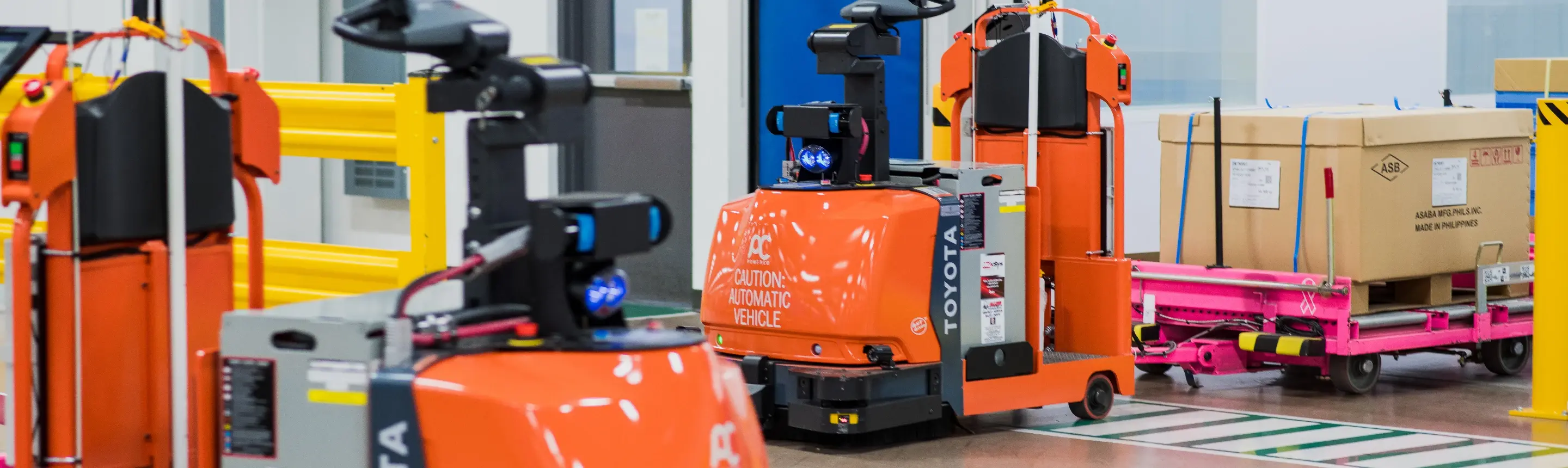
An automated guided vehicle towing several carts through a modern warehouse with yellow safety pillars.

At Toyota Automated Logistics, we analyze your operations to find the best autonomous vehicle systems to fit your application. Considerations include load characteristics such as size and weight, distance traveled, required accuracy, environmental obstacles and system compatibility.

AGVs and AMRs are deployed across a wide range of industries to support safe, consistent, and scalable material movement.

  • Warehouse and Distribution
  • Manufacturing
  • Automotive, Aerospace and Heavy Industry
  • Food and Beverage
  • E-Commerce and Retail Fulfillment
  • Cold Storage and Temperature-Controlled Facilities

Frequently Asked Questions

How do AGVs and AMRs improve ROI?

AGVs and AMRs improve ROI by reducing labor costs, minimizing safety incidents, and delivering consistent throughput across shifts. By automating repetitive transport tasks, organizations can reallocate labor to higher-value work while improving accuracy and reducing product damage. The ability to scale systems by adding vehicles also allows companies to increase capacity without major capital or facility investments.

What industries use AGVs and AMRs?

AGVs and AMRs are widely used across manufacturing, warehousing, e-commerce, food and beverage, and pharmaceutical operations. These industries rely on autonomous vehicles to transport raw materials, work-in-process (WIP), and finished goods safely and consistently. AGVs and AMRs are especially valuable in environments with repetitive transport tasks, labor shortages, high throughput requirements, or strict safety and hygiene standards.

How long does it take to implement an AGV or AMR system?

Implementation timelines vary based on facility size, system complexity, and level of integration, but most AGV or AMR systems can be deployed in a matter of weeks to a few months. Simpler applications may go live quickly, while more complex, highly integrated environments require additional planning, testing, and optimization to ensure safe, reliable operation.

How much weight can AGVs and AMRs handle?

The weight capacity of AGVs and AMRs varies by vehicle type and configuration. Some systems are designed to move small totes, cartons, or components, while others can transport full pallets weighing over 5,500 lbs. With custom frames, forks, or toppers, AGVs and AMRs can be engineered to handle unique load sizes, shapes, and weights specific to your operation.

Can AGVs and AMRs integrate with existing systems?

Yes. AGVs and AMRs can integrate with existing material handling systems such as conveyors, AS/RS, goods-to-person solutions, and warehouse execution, control, or management software (WES/WCS/WMS). This integration allows autonomous vehicles to receive tasks, report status, and coordinate material flow in real time, creating a seamless automation ecosystem without disrupting current operations.

What navigation options are available for AGVs and AMRs?

AGVs and AMRs support multiple navigation technologies, including natural feature navigation using LiDAR, vision-based navigation, and magnetic tape navigation. The best navigation method depends on layout complexity, flexibility needs, and long-term scalability goals.

Do AGVs and AMRs require facility modifications?

Many AGV and AMR systems require minimal or no facility modifications. Vehicles using natural features or vision-based navigation can operate by referencing existing walls, racks, and structures, but may require identifying reflectors or other known targets from time to time.

What support is available for AGV and AMR systems?

Toyota Automated Logistics provides comprehensive lifecycle support for AGV and AMR systems, including 24/7 technical assistance, preventative maintenance, remote diagnostics, and access to spare parts. Ongoing support ensures maximum system uptime, long-term reliability, and continuous performance optimization throughout the life of the automation system.

Navigate Automation Decisions with Confidence

Whether you're evaluating a single technology or planning a complete automation strategy, we help you choose reliable solutions that scale with your business.