

Operators of conventional, or manual, warehouses and distribution centers rely heavily on people to perform most processes. Inventory is typically stored in static racking, with associates walking the aisles to pick orders. Forklifts or basic conveyors may move loads, but there is little to no automation in place.
Without automation, manual operations often struggle to manage variable demand, SKU proliferation, supply chain disruptions, and rising customer expectations. Workforce shortages make scaling headcount difficult, limiting agility and throughput. As a result, maintaining service levels while controlling costs becomes increasingly challenging.
The path forward is not binary. Organizations do not have to choose between staying fully manual or pursuing full automation at once. Automation does not have to be an all-or-nothing leap. By starting with intermediate solutions, companies can unlock immediate efficiency gains, support their workforce, and build a scalable foundation for long-term growth.
Why Consider Intermediate Automation in a Manual Warehouse?
As automation technologies become more capable and financially attainable, the conversation is shifting. The question is no longer whether to automate, but how to do so in a way that aligns with operational priorities, workforce realities, and long-term growth plans.
Many organizations hesitate because automation feels complex or disruptive. Some are uncertain which processes will deliver the strongest return. Others believe transformation requires a full-scale, end-to-end system from the outset.
In practice, the most resilient operations take a more deliberate approach. They evaluate pressure points, identify high-impact processes, and implement solutions that strengthen performance today while laying the groundwork for future scalability.
Intermediate automation offers that bridge. It enables steady progress, measurable improvement, and strategic flexibility without forcing a complete overhaul of existing operations.
What Is Intermediate Automation?
Intermediate automation refers to semi-automated solutions deployed alongside employees. Rather than replacing people, these systems handle labor-intensive, repetitive, or injury-prone tasks while supporting workers in higher-value work.
Key characteristics include:
- Automation and employees working in coordination
- Incremental deployment aligned with business priorities
- Measurable improvements in accuracy, throughput, and safety
- A scalable framework that can evolve toward broader automation
Facilities can transition methodically, introducing one or more semi-automated solutions as business needs dictate. If supported by a strong business case, operations may later expand into more comprehensive automation.
Types of Intermediate Material Handling Automation Technology
A wide range of solutions can serve as stepping stones toward a more automated warehouse.
Conveyors and Sortation Systems
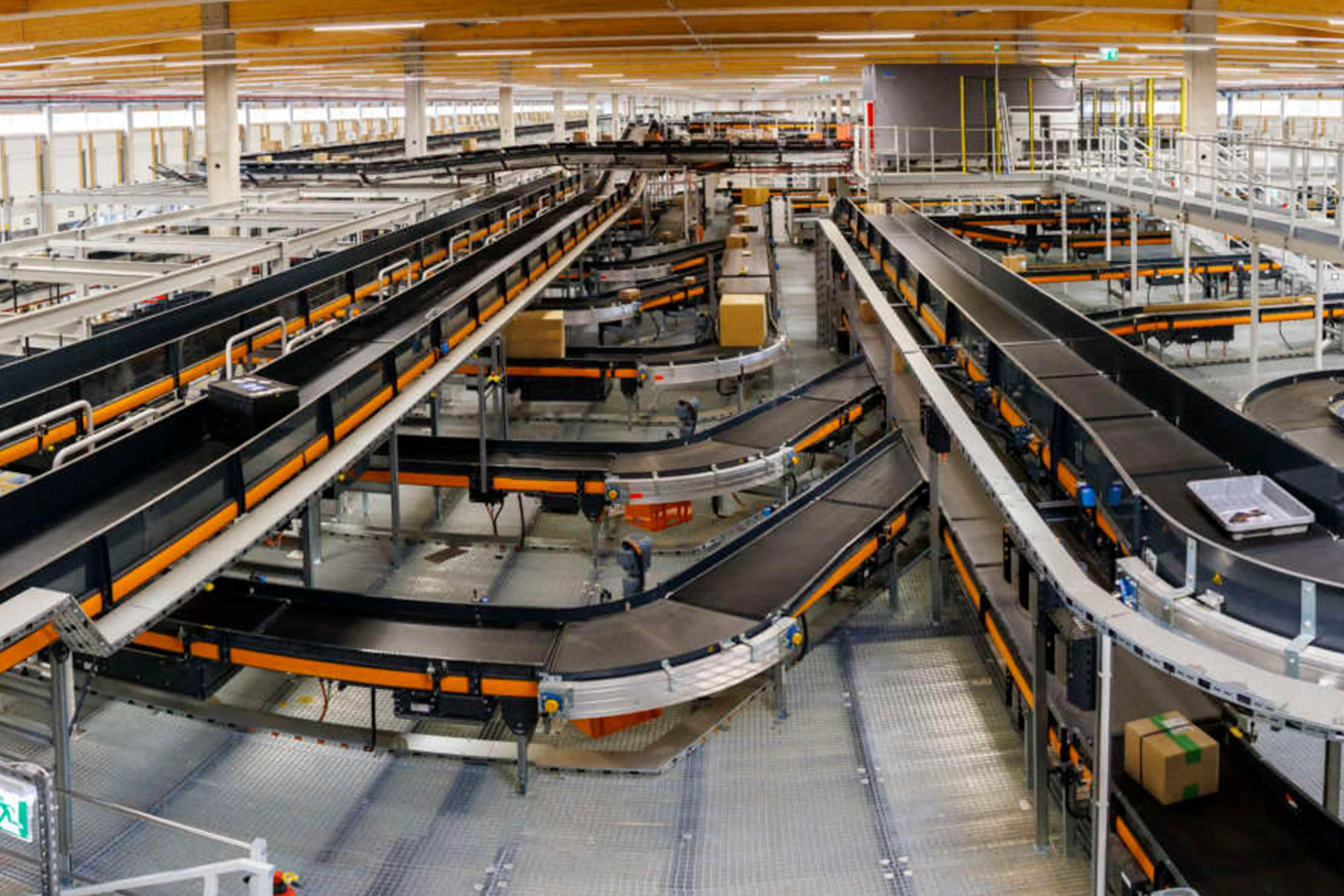
Fixed conveyor and sortation systems transport and organize inventory, cartons, parcels, and pallets throughout a facility.
Conveyors use rollers or belts to move loads, eliminating unproductive travel time. Common applications include:
- Moving totes between picking zones
- Transferring pallet loads from receiving to storage
- Delivering completed picks to packing stations
Sortation systems combine conveyors, controls, and automatic identification to direct items to specific destinations. Typical uses include routing outbound parcels to dock doors or consolidating picks prior to packing.
Autonomous Mobile Robots and Automated Guided Vehicles
Mobile robotic vehicles navigate facilities without onboard operators, efficiently transporting materials.
Autonomous Mobile Robots, or AMRs, use onboard sensors and software to move independently. These intelligent vehicles typically handle lighter loads and often interface directly with workers. Common use cases include:
- Goods-to-person picking
- Following associates through aisles to collect orders
Automated Guided Vehicles, or AGVs, transport heavier palletized loads between defined waypoints along fixed floor paths.
Robotic Picking and Palletizing
Multi-axis robotic arms, guided by sensors and software, pick and place items with precision.
Item picking robots use vacuum or gripper end effectors to select products for order fulfillment. Many incorporate artificial intelligence and machine learning to adapt to new SKUs. While not every robot can handle every product, certain applications are well-suited for robotic picking, including carton packing and workstation-based fulfillment.
Case picking robots build store-ready pallets for replenishment. Load forming software sequences case placement to match store layouts, protect fragile goods, and improve restocking efficiency.
Automated Storage and Retrieval Systems (ASRS)
Automated Storage and Retrieval Systems, or ASRS, increase storage density while optimizing facility footprint.
Robotic shuttles travel along a grid structure to store and retrieve totes, delivering inventory directly to workstations for order fulfillment. Advanced software continuously analyzes order patterns to position fast-moving items for rapid access. Modular configurations allow capacity to expand as business requirements grow.
Taking the Next Step Toward Intermediate Automation for Your Warehouse or Distribution Center
Intermediate material handling automation offers a balanced, strategic approach to modernization. It delivers operational gains, strengthens workforce productivity, and reduces dependency on manual processes without requiring a complete system overhaul.
For organizations evaluating their next step, a phased approach can provide clarity and measurable results. With the right roadmap, incremental improvements today can position an operation for long-term resilience and growth.